

A purple teaming approach in cybersecurity has become a practical method for enterprises seeking stronger defenses through collaboration between offensive and defensive security teams. It enables real-time validation of attack scenarios while improving detection and response capabilities. Instead of isolated testing, organizations gain continuous feedback on security controls. This method helps enterprises identify weaknesses faster, refine monitoring systems, and build resilient cyber defenses that evolve alongside modern threat landscapes and adversary behaviors.
Enterprise value of purple teaming in security operations
Enterprises benefit from faster detection engineering validation, reduced security blind spots, and improved alignment between security tools and real-world attack behavior. By simulating adversary techniques in controlled environments, teams can confirm whether alerts trigger correctly and whether analysts respond effectively. This reduces uncertainty in security operations and strengthens confidence in defense systems. It also ensures that security investments deliver measurable improvements rather than theoretical protection alone across enterprise environments.
A major advantage of purple teaming is its ability to improve detection coverage by directly mapping attacker techniques to defensive controls. Security teams can observe exactly where monitoring fails and adjust rules during the exercise. This reduces the time between identifying and fixing vulnerabilities. It also strengthens threat visibility across endpoints, networks, and cloud systems, ensuring enterprises gain a more accurate understanding of their security posture and exposure levels overall.
Faster feedback loops and operational improvement
Enterprises adopting purple teaming also gain faster feedback loops between offensive simulations and defensive tuning. Instead of waiting for post-engagement reports, teams adjust configurations in real time, improving operational efficiency. This approach enhances collaboration between engineers and analysts while reducing delays in remediation. Platforms such as swarmnetics.com provide insights into structured security practices that support continuous improvement and modern detection engineering strategies across complex enterprise environments helping organizations mature their cybersecurity capabilities effectively.
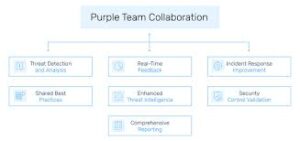
A purple teaming model also improves incident response readiness by repeatedly testing how analysts react to simulated threats. Teams become more confident in escalation procedures, investigation steps, and containment actions. This repeated exposure reduces confusion during real attacks and improves decision-making speed. Over time, organizations build stronger operational resilience and ensure that response workflows are aligned with real-world adversary behavior and evolving threat patterns across enterprise environments.
Strategic and financial benefits for enterprises
Another benefit for enterprises is improved alignment between security investments and actual risk reduction. Because every control is tested against realistic attack scenarios, organizations can prioritize spending on tools that demonstrate measurable effectiveness. This reduces wasted resources and improves return on security investment. It also helps leadership understand which defenses are working and which require improvement, leading to more informed decision-making across cybersecurity programs and governance structures.
Enterprises also benefit from stronger cross-team collaboration, as offensive and defensive experts work together instead of operating in silos. This shared environment builds mutual understanding of attacker tactics and defensive limitations. It encourages knowledge transfer and skill development across security teams. Over time, this leads to a more unified security culture where communication is faster, and operational efficiency improves across all layers of enterprise cybersecurity functions. This ultimately strengthens long-term organizational resilience.
Continuous improvement through purple teaming practices
A purple teaming strategy delivers long-term benefits by continuously refining detection, response, and prevention capabilities. Enterprises gain ongoing validation of security controls and faster adaptation to evolving threats. This approach ensures cybersecurity teams remain proactive rather than reactive. Ultimately, it creates a sustainable improvement cycle that enhances resilience, reduces risk exposure, and strengthens enterprise security maturity across all operational environments making defenses more adaptive and aligned with modern cyber risk.